The Trust Vacuum in Decentralized Physical Infrastructure Networks
Decentralized Physical Infrastructure Networks (DePINs) generate continuous, high-frequency telemetry streams—from atmospheric sensor arrays and energy grid monitors to distributed GPU clusters. For quantitative models consuming this data, the fundamental axiom is temporal provenance: the assurance that a data point $d_i$ was generated at time $t_i$ and has remained immutable since.
Traditional architectures rely on trusted timestamping authorities (TSAs) or centralized database administrators. In DePIN, where the data provider is an anonymous, economically incentivized node operator, this trust assumption is a critical vector for manipulation. A node operator can retroactively alter a temperature reading or backdate a computational proof if they control the data ingestion pipeline.
To eliminate this trust vacuum, we require a commitment scheme where the cost of retroactive alteration scales exponentially with the security budget of the underlying network. Bitcoin provides this via its proof-of-work consensus. However, committing every individual telemetry reading to the Bitcoin blockchain is economically unfeasible. At Kairos Signal, we solve this through deterministic Merkle batch aggregation and OpenTimestamps integration, achieving sub-cent timestamping with cryptographic tamper evidence.
Architectural Primer: Deterministic Batch Aggregation
Given a daily batch $B$ of $N$ telemetry values from a specific DePIN subnetwork, we define the dataset as an ordered sequence:
$$ B = \{d_1, d_2, \dots, d_N\} $$
where each $d_i$ is a strictly typed, serialized payload (e.g., Protocol Buffers or CBOR) containing the sensor reading, the epoch timestamp, and the node's cryptographic signature.
To commit to $B$, we cannot simply hash the concatenation of all elements. Such a scheme requires possessing the entire dataset to verify the integrity of a single point, violating the principle of efficient subsetting. Instead, we construct a binary Merkle tree.
Preventing Second Preimage Attacks
A naive Merkle implementation is vulnerable to
a subtle but critical flaw. Consider a standard implementation:
def merkle_root(leaves):
    # leaves must be sorted before hashing to prevent reordering attacks
    leaves = [sha256(x) for x in leaves]
    while len(leaves) > 1:
        if len(leaves) % 2 == 1:
            leaves.append(leaves[-1])  # duplicate the last leaf
        leaves = [sha256(a + b) for a, b in zip(leaves[0::2], leaves[1::2])]
    return leaves[0]
The second-preimage attack exploits the fact that the concatenation a + b is ambiguous. An attacker can find x such that sha256(x) == sha256(a + b) and substitute it, breaking the binding of the tree. The standard mitigation is to domain-separate every hash — prepend a prefix that marks whether a node is a leaf or an interior node:
def merkle_root(leaves):
    leaves = [sha256(b"leaf" + x) for x in sorted(leaves)]
    while len(leaves) > 1:
        if len(leaves) % 2 == 1:
            leaves.append(leaves[-1])
        leaves = [sha256(b"node" + a + b) for a, b in zip(leaves[0::2], leaves[1::2])]
    return leaves[0]
Because leaf and interior hashes are now in disjoint domains, a leaf cannot be replayed as an interior node and vice versa. This is the construction we use for every daily batch.
Anchoring to Bitcoin via OpenTimestamps
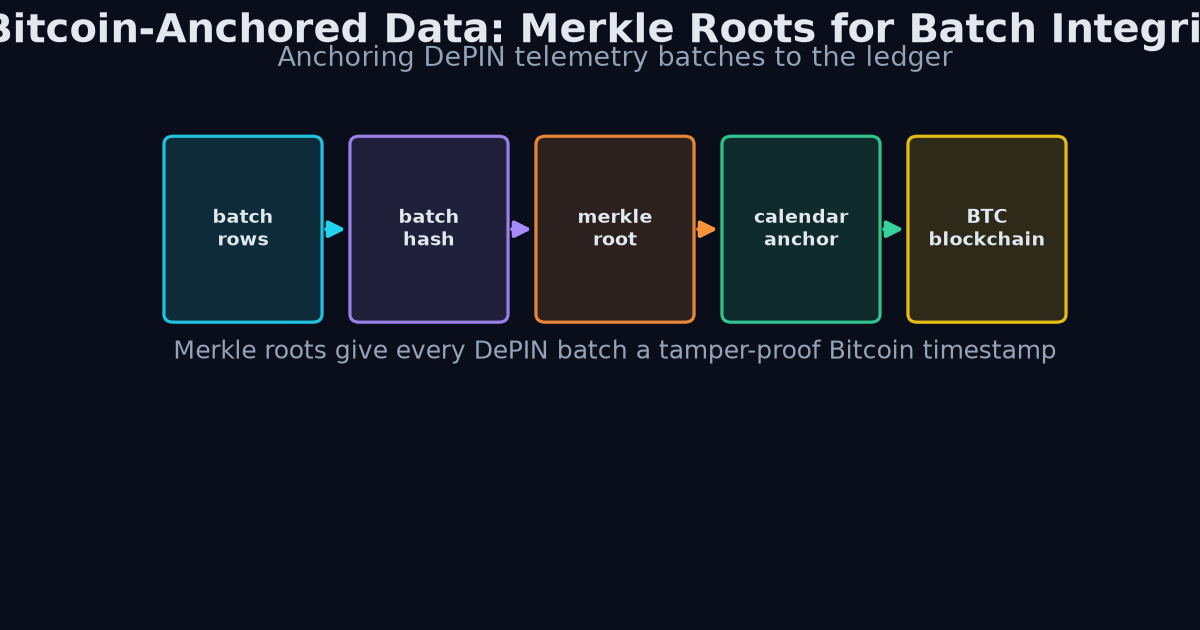
Committing a Merkle root to Bitcoin does not require a full transaction. We use OpenTimestamps to embed a hash of the batch root into the Bitcoin blockchain via a commitment embedded in an existing transaction's OP_RETURN or via the calendar aggregation service. The cost is sub-cent per batch, and the proof is verifiable by anyone without trusting us.
The audit trail is:
Verifying a Single Data Point
A consumer who wants to verify a single value in a historical batch needs only the Merkle proof path, not the entire dataset. They:
leaf domain separator.If they match, the value provably existed in that batch at the time the root was anchored — with the full security of the Bitcoin network. This is what makes our data tamper-evident: retroactively altering any historical value would require recomputing a Merkle root that still matches the immutable Bitcoin anchor.
Across 372 networks and 11,857 live series, every daily batch is anchored this way. You can independently verify any number we publish, without trusting us as an intermediary. That is the difference between a data product and a claim.
Verify a batch yourself:
# Fetch the provenance root for a batch
curl "https://api.kairossignal.com/v1/provenance" -H "X-API-Key: *"
---
Try it yourself
Query the live catalog, supply telemetry, and provenance receipts directly: /v1/networks, /v1/supply on the REST API.
Related reading: DePIN data provenance · Merkle-rooted batch integrity · how verify_url works · how we verify every DePIN number
Design-partner seats are capped at 20 at a lifetime-locked $199/mo (full API access, every published endpoint, MCP server, Bitcoin-anchored provenance). After seat 20 the price becomes $249/mo. Claim a design-partner seat → · See pricing---
Get Started With DePIN Intelligence
Kairos Signal provides verifiable, provenance-first telemetry for DePIN networks, including first-party supply data read directly from a network's own API or blockchain. Every value carries a verify_url you can check yourself, and each daily batch is Merkle-rooted and anchored to Bitcoin.
Every API response is signed with ed25519 and timestamped. You can prove what was served and when, months later. That is what we mean by provenance-first.
Related reading: DePIN Intelligence Guide · DePIN Telemetry · How to Query DePIN Data · DePIN Data Verification · Pricing