 How We Handle Network Partitions During Ingestion
At Kairos Signal, we pride ourselves on delivering enriched signals using our MCP‑native infrastructure. Handling network partitions efficiently during data ingestion is critical to maintaining the reliability and scalability of our pipelines. This article delves into the technical strategies and best practices we employ to mitigate the impact of network partitions while ensuring seamless data flow.
Understanding Network PartitionsA network partition occurs when a portion of the distributed system loses connectivity with the rest of the nodes, often due to hardware failures, software bugs, or routing issues. In high‑throughput environments like ours, where real‑time data ingestion is paramount, such partitions can lead to significant latency and data loss if not properly managed.
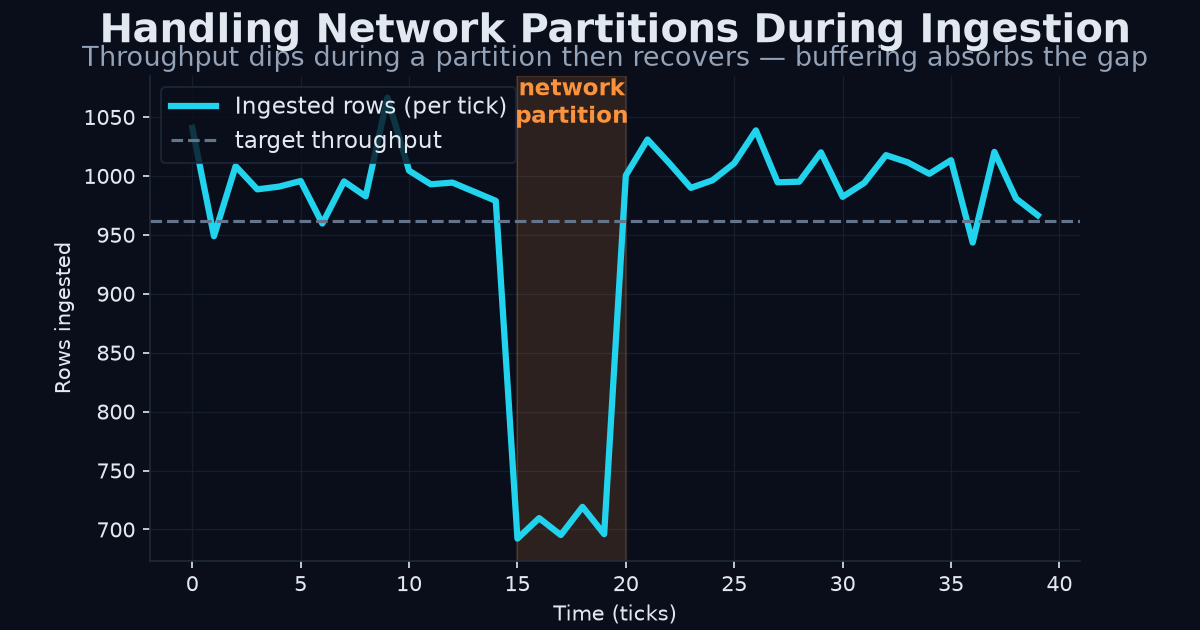
Strategies for Resilient IngestionDuring a recent production incident where a subset of our edge nodes experienced connectivity issues due to a network hardware failure, we employed the above strategies in real time. By leveraging our circuit breaker logic, data ingestion services seamlessly switched to backup paths without impacting end users. Post‑incident analysis revealed that our event sourcing model allowed us to replay all missed events within minutes, ensuring no loss of critical market signals.
Scaling to High Throughput EnvironmentsAs we continue scaling to support enriched signals across multiple metros and verticals, maintaining resilience against network partitions becomes increasingly complex. Our infrastructure leverages containerization (Docker) and orchestration tools (Kubernetes) to ensure rapid deployment of resilient services that can adapt dynamically to changing network conditions.
Next Steps for YouIf you’re interested in exploring how Kairos Signal’s MCP‑native capabilities can enhance your data operations, we invite you to discover our data products here. Additionally, if you’d like to leverage these solutions at scale within your organization, consider our enterprise offerings available through a secure checkout process: Checkout Kairos Signal Now.
By adopting similar resilient design patterns and leveraging our expertise in data engineering, we can help ensure that your critical workflows remain uninterrupted even in the face of network partitions. Let’s build a more robust, scalable data ecosystem together.
``
---
Try it yourself
Why Partition Handling Matters for Data Integrity
When an upstream network's API goes down mid-collection, the naive response is to write nothing — leaving a gap that downstream consumers mistake for zero. Worse, a partial write can produce a half-updated snapshot that looks valid. Both corrupt the temporal history that is the core value of a DePIN data product.
Our approach treats partition handling as a data-integrity problem, not just an availability problem. When a partition is detected, affected values are marked with a freshness_verdict of stale or missing rather than silently dropped or zero-filled. This preserves the honesty of the record — a consumer can tell that the network was unobservable at a given time, instead of assuming it reported nothing.
The Retry and Reconciliation Loop
A robust pipeline does not just survive a partition; it reconciles it. After connectivity is restored, we backfill the missed window from the upstream source and verify the backfilled values against the source before merging them into the series. Because every value carries a verify_url and daily batches are Merkle-rooted, the reconciliation is auditable — a consumer can confirm that a backfilled value genuinely came from the source at the recorded time.
Query the live catalog, supply telemetry, and provenance receipts directly: /v1/networks, /v1/supply on the REST API.
Related reading: the JSONL→ClickHouse pipeline · our SQLite buffer layer at 100GB · the data engineers guide to clickhouse optimization · DePIN infrastructure data
Design-partner seats are capped at 20 at a lifetime-locked $199/mo (full API access, every published endpoint, MCP server, Bitcoin-anchored provenance). After seat 20 the price becomes $249/mo. Claim a design-partner seat → · See pricing---
Why This Matters for DePIN Intelligence
The DePIN sector has grown, but the data infrastructure to analyze its networks remains fragmented. Most platforms aggregate token prices and market caps from CoinGecko or DefiLlama — useful, but not sufficient for infrastructure analysis. The scarce layer is supply-side telemetry: actual node counts, GPU supply, storage capacity, bandwidth deployed, and utilization ratios. These numbers live on many different data sources, each with its own API format, rate limits, and update cadence.
Kairos Signal exists to solve that problem. We maintain collectors across blockchains and first-party network APIs, normalizing everything into a single schema with provenance on every row. The result is live series across DePIN networks, including first-party telemetry — data read directly from the network's own endpoint, not estimated or imputed.
For developers building DePIN analytics tools, researchers evaluating network health, or traders assessing supply-demand dynamics, this means one API call instead of 50. For autonomous AI agents, the MCP server provides structured access with self-serve credits — no human, no card, just USDC on Base.
Get Started With DePIN Intelligence
Kairos Signal provides verifiable, provenance-first telemetry for DePIN networks, including first-party supply data read directly from a network's own API or blockchain. Every value carries a verify_url` you can check yourself, and each daily batch is Merkle-rooted and anchored to Bitcoin.
Three ways to access:Every API response is signed with ed25519 and timestamped. You can prove what was served and when, months later. That is what we mean by provenance-first.
Related reading: DePIN Intelligence Guide · DePIN Telemetry · How to Query DePIN Data · DePIN Data Verification · Pricing Correction 2026-09-25: this post called our catalog entry count a count of DePIN networks; that count includes superseded rows and Bittensor subnet rows. It has been removed, together with some present-tense coverage counts written beside it. Current coverage figures: /v1/networks.