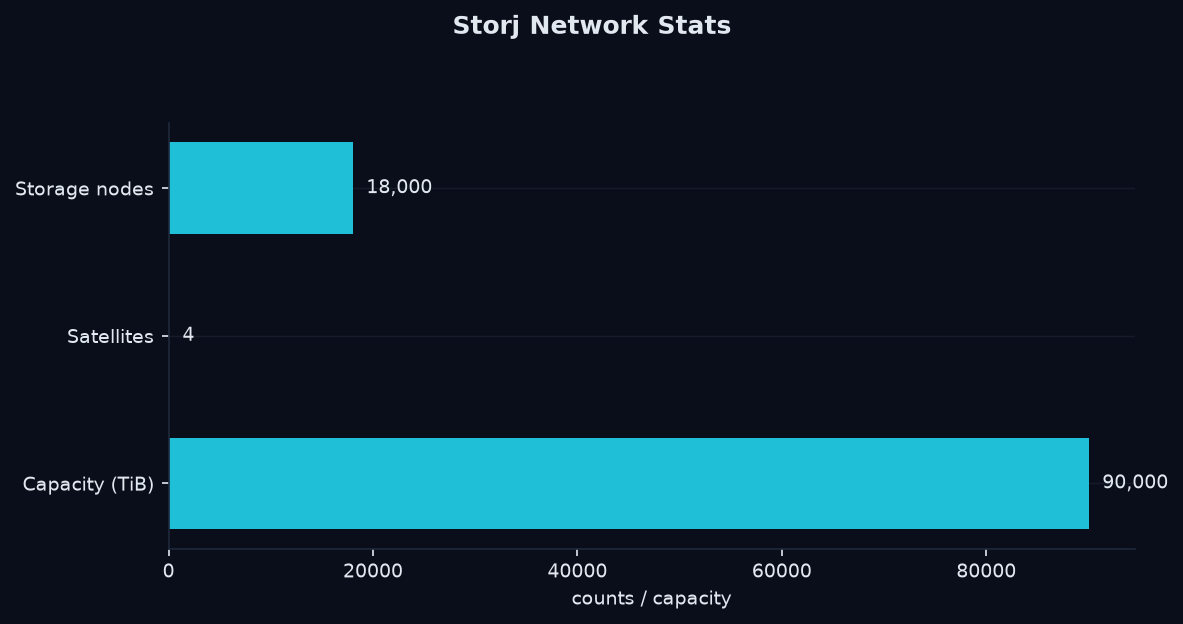
Storj: Storage With a Satellite Architecture
Storj is one of the oldest and most battle-tested storage DePINs. Its architecture is distinctive: client traffic is coordinated by satellites — trusted metadata and accounting services — which manage fleets of storage nodes run by operators around the world. Understanding that structure is key to reading the network's stats correctly.
The Two-Denominator Problem
Storj data has a subtlety that trips up naive queries. Node count and capacity can be measured in two ways:
- Registered / eligible — nodes that could store data.
- Active / earning — nodes actually holding data and earning.
Satellites Are a Health Signal
Satellite count and satellite-side stats matter because satellites are the coordination layer. A healthy Storj network has satellites operating correctly, because every storage and retrieval flows through them. Their status is a network-health metric independent of raw node counts.
A Worked Read
Suppose eligible nodes number in the thousands but earning nodes are a fraction of that. The gap tells you a large pool of registered capacity isn't being used. For capacity planning that's important — those idle nodes could be activated — but for judging current network activity, earning nodes are the real number. Track both denominators and you never overstate the network.
Query Storj Stats
# Nodes + satellites + capacity
curl "https://api.kairossignal.com/v1/networks/storj" \
  -H "X-API-Key: *"
The utilization-relevant split
curl "https://api.kairossignal.com/v1/networks/storj?fields=storage_nodes,active_nodes,capacity_tib"
Compare storage capacity across the storage category
curl "https://api.kairossignal.com/v1/compare?concept=STORAGE_CAPACITY&category=storage"
Every value carries a verify_url, an as_of timestamp, and a freshness verdict — you can confirm node or capacity numbers against Storj's own explorer.
Why the Denominator Matters
The two-denominator problem is the difference between "Storj has thousands of nodes" and "Storj has a few thousand working nodes." Both are true, but they answer different questions. A marketing page quotes the first; a data product serves both and lets you choose. That is the kind of distinction that separates real telemetry from vanity metrics.
First-Party and Anchored
Storj is among the 44 networks we read via dedicated first_party_api collectors. The daily batch is Merkle-rooted and timestamped to Bitcoin via OpenTimestamps, so a historical capacity reading is provably the value that was true that day.
FAQ
What is a satellite in Storj? A trusted metadata and accounting service that coordinates storage and retrieval between clients and storage nodes. Satellite health is a network-health signal independent of node counts. Why two denominators for nodes? Eligible nodes could store data; earning nodes actually do. The gap is the utilization signal. Serving only one would over- or understate the network. How does Storj compare to Filecoin? Both normalize into canonical storage concepts, so you can compare capacity and nodes in a singlecompare query.
Storj in the Storage Category
Storj anchors the storage category alongside Filecoin. Comparing their canonical metrics — raw capacity, active nodes, deal or object volume — in one query is exactly what a normalized DePIN API enables.
Get a free API key → · Read the docs →The Satellite Architecture in Data Terms
Storj's satellite architecture shapes its data picture. Because clients interact through satellites, satellite-side stats — their status, the number of active satellites, the traffic they coordinate — are a network-health metric independent of raw node counts. A network can have a large node fleet and a coordination layer that's struggling, or a modest fleet and a healthy coordination layer. Tracking both layers tells you more than either alone.
The Eligible-vs-Earning Split
The eligible-vs-earning split is Storj's version of the registered-vs-active distinction that runs through all of DePIN. Eligible nodes could store data; earning nodes actually do. The gap is the utilization story. A node that's registered but idle contributes capacity in theory and nothing in practice. When you're sizing Storj for a workload, the earning-node count and real capacity are the numbers that matter — and only telemetry separates them from the marketing-friendly eligible count.
Comparing Storj Across the Category
Storj and Filecoin are the two anchors of the storage category, and they're directly comparable because both normalize into canonical storage concepts — STORAGE_CAPACITY, NODES_ACTIVE, and so on. A single compare query across the storage category lets you see, at a glance, who has real capacity and who has registered-only inventory. That cross-network view is the payoff of a canonical schema.
Read more: Filecoin Data API · DePIN Data Comparison · DePIN Network Data
---
This is a data product. Kairos Signal publishes no trading signals, performance returns, win rates, or accuracy claims.---
Try it yourself
Query the live catalog, supply telemetry, and provenance receipts directly: /v1/supply, /v1/provenance on the REST API.
Related reading: the two-denominator problem in Storj · DePIN infrastructure data · how we read supply telemetry from 296 networks · DePIN network data: 372 networks, 138 sources
Design-partner seats are capped at 20 at a lifetime-locked $199/mo (full API access, every published endpoint, MCP server, Bitcoin-anchored provenance). After seat 20 the price becomes $249/mo. Claim a design-partner seat → · See pricing---
Get Started With DePIN Intelligence
Kairos Signal provides verifiable, provenance-first telemetry for DePIN networks, including first-party supply data read directly from a network's own API or blockchain. Every value carries a verify_url you can check yourself, and each daily batch is Merkle-rooted and anchored to Bitcoin.
Every API response is signed with ed25519 and timestamped. You can prove what was served and when, months later. That is what we mean by provenance-first.
Related reading: DePIN Intelligence Guide · DePIN Telemetry · How to Query DePIN Data · DePIN Data Verification · Pricing