Filecoin: The Storage Layer of DePIN
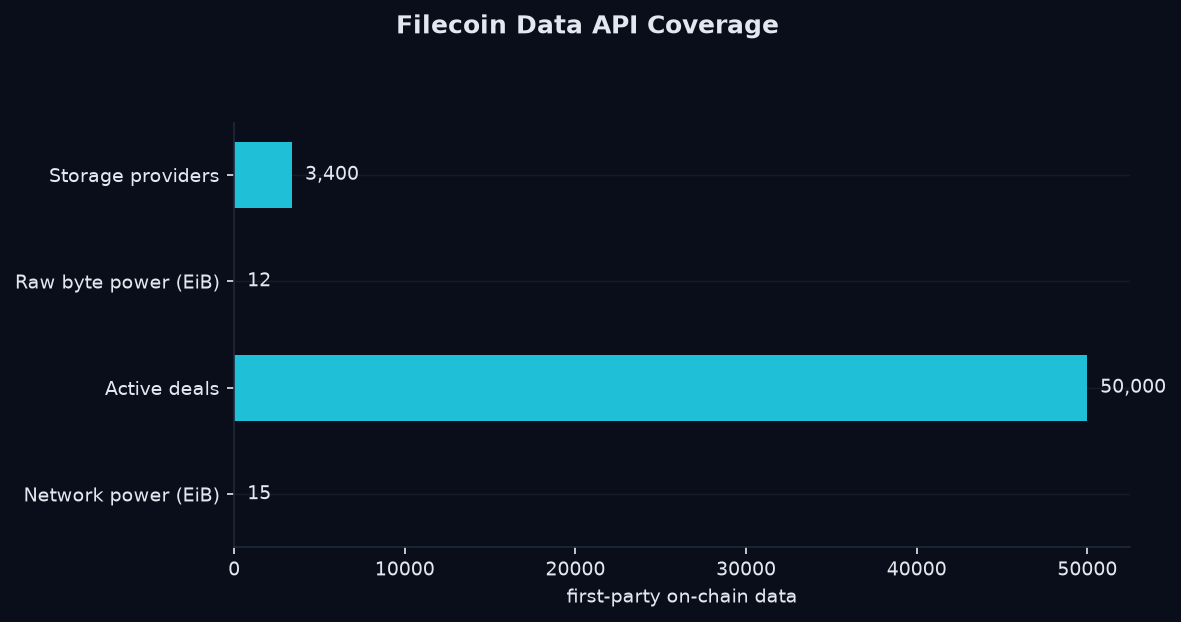
Filecoin is the deepest storage network in DePIN, and it is uniquely transparent because the storage layer is on-chain. Storage providers, raw byte power, network power, and active deals are all recorded on the chain and readable via first-party sources. That makes Filecoin one of the best-served networks in any DePIN data API.
The Power Question: Raw vs Network Power
The most common Filecoin mistake is conflating two very different numbers:
- Raw byte power — the total raw storage capacity committed by providers, in EiB.
- Network power — the same capacity weighted by the network's consensus rules (Quality Adjusted Power), which multiplies certain storage types.
Storage Providers and Deals
Two more pieces round out the picture:
- Storage providers — how many provider nodes are actively sealing and storing data.
- Active deals — how many storage deals are live between providers and clients. Deals are the actual economic activity; provider count without deal volume overstates health.
A Worked Capacity Read
Consider two readings: raw byte power of 12 EiB and network power of 15 EiB. The ratio (network/raw > 1) tells you a meaningful fraction of capacity is verified/replicated storage being weighted up by consensus. If you had used only raw power, you'd have understated the network's consensus influence; if you'd used only network power for a "how much physical disk" question, you'd have overstated it. The two denominators answer different questions — track both.
Query Filecoin Data
# Provider + power + deals in one call
curl "https://api.kairossignal.com/v1/networks/filecoin" \
  -H "X-API-Key: *"
Power-specific fields (raw vs network power)
curl "https://api.kairossignal.com/v1/networks/filecoin?fields=raw_byte_power,network_power,active_deals"
Compare storage capacity across the storage category
curl "https://api.kairossignal.com/v1/compare?concept=STORAGE_POWER&category=storage"
Every value carries a verify_url pointing at the Filecoin chain explorer, an as_of timestamp, and a freshness verdict. You can confirm any power or deal number against the chain yourself.
The Deal-Volume Signal
Active deals are the truest economic signal for a storage network. A provider count can grow from speculative node operators; deal volume only grows when clients actually pay to store data. When you're evaluating Filecoin, watch active deals as the leading indicator, with provider count and power as supporting context.
First-Party On-Chain Sourcing
Filecoin data is read first-party — from the chain itself — which means no third-party indexer sits between the network and our store. The daily batch is Merkle-rooted and timestamped to Bitcoin via OpenTimestamps, so a historical power reading is provably the value that was true that day.
FAQ
What is the difference between raw byte power and network power? Raw byte power is total committed storage in EiB; network power is that capacity weighted by consensus (Quality Adjusted Power). The ratio reveals what kind of storage is committed. Is Filecoin data on-chain? Yes — providers, power, and deals are all recorded on the chain and read first-party. No third-party indexer in the path. How do I compare Filecoin to Storj? Both normalize into canonical storage concepts (STORAGE_POWER, STORAGE_CAPACITY), so you can compare them in one compare query.
Storage in Context
Filecoin anchors the storage category alongside Storj and others. Comparing their canonical metrics — raw capacity, active nodes, deal volume — is exactly what a normalized DePIN API enables. One query, comparable numbers, verified sources.
Get a free API key → · Read the docs →The Two Denominators in Practice
The raw-vs-network power distinction is not academic — it changes real decisions. A storage network with high raw byte power but low network power is committing mostly unweighted (lower-quality) storage. A network with high network power relative to raw is leaning on verified and replicated storage types that consensus weights up. Two networks with identical raw power can have very different consensus influence, and an analysis that ignores the denominator will misread both.
We track both denominators as separate canonical concepts, so you can compute the ratio yourself or read either one directly. Never guess which number a report is quoting.
Why Active Deals Matter More Than Provider Count
Provider count is a supply-side number; active deals are the demand-side reality. Providers can register speculatively, but deals only exist when clients actually pay to store data. When you're evaluating Filecoin's economic health, watch active deals as the leading indicator. Rising providers with flat deals is inventory accumulation; rising deals is genuine demand. The two read together tell you whether Filecoin is growing into real use or just into more capacity.
Read more: Storj Network Stats · DePIN On-Chain Data · DePIN Network Data
---
This is a data product. Kairos Signal publishes no trading signals, performance returns, win rates, or accuracy claims.---
Try it yourself
Query the live catalog, supply telemetry, and provenance receipts directly: /v1/supply, /v1/provenance on the REST API.
Related reading: filecoin storage capacity api how to query petabytes · filecoin storage stats pb vs eib understanding capacity units · DePIN infrastructure data · the DePIN developer guide
Design-partner seats are capped at 20 at a lifetime-locked $199/mo (full API access, every published endpoint, MCP server, Bitcoin-anchored provenance). After seat 20 the price becomes $249/mo. Claim a design-partner seat → · See pricing---
Get Started With DePIN Intelligence
Kairos Signal provides verifiable, provenance-first telemetry for DePIN networks, including first-party supply data read directly from a network's own API or blockchain. Every value carries a verify_url you can check yourself, and each daily batch is Merkle-rooted and anchored to Bitcoin.
Every API response is signed with ed25519 and timestamped. You can prove what was served and when, months later. That is what we mean by provenance-first.
Related reading: DePIN Intelligence Guide · DePIN Telemetry · How to Query DePIN Data · DePIN Data Verification · Pricing