Filecoin API: Storage Providers, Network Power & Deal Metrics
What the Metrics Tell You
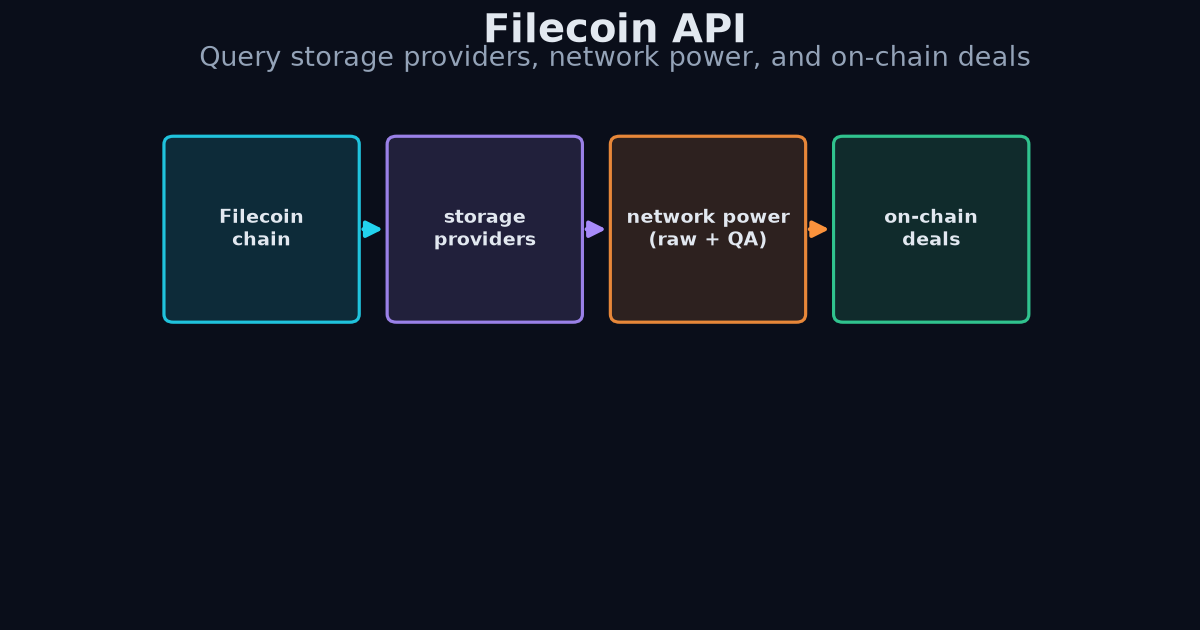
Filecoin's key metrics — storage providers, raw power, quality power, and active deals — answer different questions:
- Storage providers — how distributed the network's supply is.
- Raw power — total physical capacity under management.
- Quality power — capacity weighted for useful, verified deals; determines consensus and rewards.
- Active deals — the demand actually being served right now.
A Usage Scenario
Consider a storage-costing tool that compares Filecoin to object storage tiers. The naive version uses raw capacity and list price, and concludes decentralized storage is dramatically cheaper. The honest version normalizes for utilization — a fraction of registered capacity is actually under active deal — and for the PiB/EiB unit trap, before making any comparison.
With canonical, first-party storage data, the tool reads storage_registered, storage_active, and storage_utilization for Filecoin, applies the declared units, and produces a comparison that reflects the real economics rather than a marketing number. That is the difference between a storage dashboard and a storage decision tool.
Filecoin (FIL) is the largest decentralized storage network by capacity. Tracking storage providers, raw power, and deal activity is critical for DePIN analytics and storage pricing research.
What We Track for Filecoin
- Storage providers (miners) — from Filecoin's own API
- Network raw power — from Filecoin stats
- Network quality power — from Filecoin stats
- Active deals — from Filecoin's API
- Protocol revenue — from DefiLlama
- Price & market cap — from CoinGecko
Why Raw Power vs. Quality Power Matters
Filecoin exposes two power figures that are routinely conflated: raw byte power (simple storage capacity) and quality-adjusted power (weighted by deal duration, verified deals, and replication). Quality power is what determines consensus and rewards, and it is always higher than raw power because Filecoin incentivizes useful, long-duration, verified storage.
For a DePIN analytics tool, the choice of denominator changes the story:
- Raw power tells you how much physical capacity the network commands.
- Quality power tells you how much of that capacity is being put to economically useful work.
What We Track for Filecoin
- Storage providers (miners) — from Filecoin's own API
- Network raw power — from Filecoin stats
- Network quality power — from Filecoin stats
- Active deals — from Filecoin's API
- Protocol revenue — from DefiLlama
- Price & market cap — from CoinGecko
Why Verifiable Storage Data Matters
For a developer building a storage-pricing tool, utilization — active deals over registered capacity — is the real signal. For an investor, raw-vs-quality power separates capacity growth from useful growth. For an AI agent, canonical, unit-declared storage data prevents the PiB/EiB and raw-vs-quality errors that silently corrupt downstream decisions.
Every value we serve carries a verify_url to the Filecoin chain explorer, and every daily batch is Merkle-rooted to Bitcoin via OpenTimestamps. The storage capacity you read today is provably today's value — not a modeled estimate.
Query Filecoin Data
# Get all Filecoin metrics with provenance
curl "https://api.kairossignal.com/v1/networks/filecoin" \
  -H "X-API-Key: YOUR_KEY"
Compare with other storage networks (Storj, Arweave, etc.)
curl "https://api.kairossignal.com/v1/compare?network=filecoin&concept=STORAGE_ACTIVE" \
  -H "X-API-Key: YOUR_KEY"
Free API Key — $5 Credits
curl -X POST https://kairossignal.com/v1/credits/register \
  -H "Content-Type: application/json" \
  -d '{"email":"[email protected]"}'
---
Try it yourself
Query the live catalog, supply telemetry, and provenance receipts directly: /v1/networks, /v1/supply on the REST API.
Related reading: Filecoin data API · filecoin storage capacity api how to query petabytes · filecoin storage stats pb vs eib understanding capacity units · DePIN infrastructure data
Design-partner seats are capped at 20 at a lifetime-locked $199/mo (full API access, every published endpoint, MCP server, Bitcoin-anchored provenance). After seat 20 the price becomes $249/mo. Claim a design-partner seat → · See pricing---
Get Started With DePIN Intelligence
Kairos Signal provides verifiable, provenance-first telemetry for DePIN networks, including first-party supply data read directly from a network's own API or blockchain. Every value carries a verify_url you can check yourself, and each daily batch is Merkle-rooted and anchored to Bitcoin.
Every API response is signed with ed25519 and timestamped. You can prove what was served and when, months later. That is what we mean by provenance-first.
Related reading: DePIN Intelligence Guide · DePIN Telemetry · How to Query DePIN Data · DePIN Data Verification · Pricing