What DePIN TVL Measures
Total Value Locked (TVL) in DePIN is not the same animal as DeFi TVL. In DeFi, TVL is capital deposited into liquidity and lending protocols — productive, interest-earning. In DePIN, TVL is mostly value locked into network security and reputation: staked tokens, operator collateral, and reserves that back the infrastructure layer.
That distinction matters. A DePIN's TVL tells you how much capital the market has committed to the network's trust model — staking to run nodes, collateralizing operator slots, securing compute and storage. It is a confidence and security signal, not a liquidity signal.
Coverage
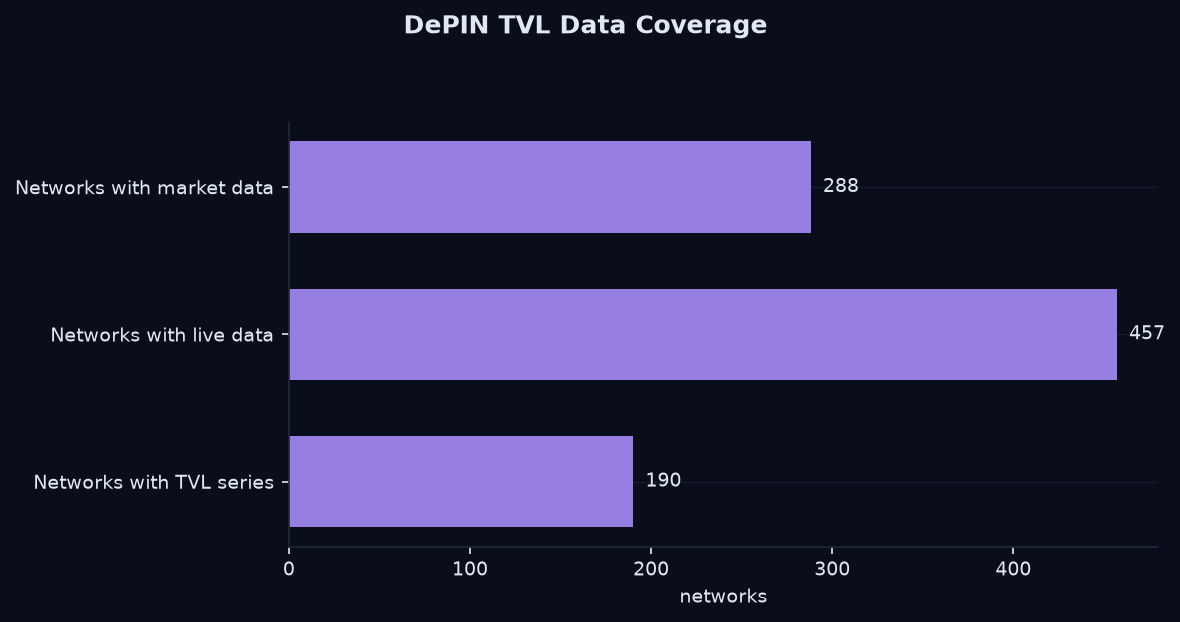
TVL data is part of the market/on-chain layer, which we track across a subset of the 372 networks with live data. It sits alongside token supply, market cap, and price, all read from first-party sources with provenance on every value.
| Data type | Networks | |---|---| | Networks with live data | 327 | | With market data (price, market cap) | CoinGecko-sourced: 288 | | With TVL / staking series | subset with on-chain value |
The DePIN TVL Signal
Read correctly, DePIN TVL answers a specific question: how much capital is locked into the network's security and reputation? For networks like Render (RNDR staking) or Livepeer (LPT staking), that locked value is a direct measure of the market's commitment to the network's operation. A rising TVL with falling token price can signal accumulation of committed capital; a falling TVL is capital leaving the trust model.
TVL vs DeFi TVL
The common error is treating DePIN TVL as a liquidity metric. In DeFi, high TVL means deep liquidity and productive capital. In DePIN, TVL is mostly staked security — capital that backs reputation but doesn't itself earn. So a DePIN with a big TVL is a network with strong committed backing, not necessarily strong revenue. Read it as confidence, not productivity.
Query TVL Data
# TVL + supply for one network
curl "https://api.kairossignal.com/v1/networks/render?fields=tvl,rndr_staked" \
  -H "X-API-Key: *"
TVL across a category
curl "https://api.kairossignal.com/v1/compare?concept=TVL&category=compute"
TVL trend
curl "https://api.kairossignal.com/v1/supply?network=livepeer&metric=tvl&window=90d"
Every value carries a verify_url, an as_of timestamp, and a freshness verdict. Confirm any TVL reading against the chain or explorer.
TVL + Fees + Utilization
TVL is one leg of a three-legged diligence stool. TVL shows committed capital; protocol fees show real revenue; utilization shows real demand. A network with high TVL, real fees, and active utilization is a fundamentally different investment than one with high TVL and nothing underneath. The normalized API lets you read all three in comparable units in one query.
Daily batches are Merkle-rooted and timestamped to Bitcoin via OpenTimestamps, so a historical TVL reading is provably the value that was true that day.
FAQ
How is DePIN TVL different from DeFi TVL? DeFi TVL is productive liquidity; DePIN TVL is mostly staked security and collateral. Read it as confidence in the network's trust model, not as productivity. What does a rising TVL tell me? It tells you capital is being committed to the network's security/reputation. Cross-check with fees and utilization to see whether that capital is earning. Can I compare TVL across networks? Yes —TVL is a canonical concept, comparable across networks in one compare query.
Explore TVL data → · Get a free key →
Staking vs Liquidity: Reading DePIN TVL Right
The single most common error in DePIN TVL is treating it like DeFi TVL. In DeFi, TVL is productive liquidity earning yield. In DePIN, TVL is mostly staked security and collateral — capital that backs the network's reputation but doesn't itself earn. A high DePIN TVL means strong committed backing, not strong revenue. Read it as a confidence signal, and always cross-check against fees and utilization to see whether that backing is producing work.
The Three-Legged Stool
TVL is one leg of a diligence stool, and it's the weakest on its own:
- TVL — how much capital is committed to the network.
- Protocol fees — how much the network actually earns.
- Utilization — how much demand the network is serving.
Read more: DePIN Protocol Fees · DePIN On-Chain Data · Render Network Data
---
This is a data product. Kairos Signal publishes no trading signals, performance returns, win rates, or accuracy claims.---
Try it yourself
Query the live catalog, supply telemetry, and provenance receipts directly: /v1/provenance on the REST API.
Related reading: calculating true network value · why supply data matters more than price · DePIN on-chain data · DePIN analytics pipeline
Design-partner seats are capped at 20 at a lifetime-locked $199/mo (full API access, every published endpoint, MCP server, Bitcoin-anchored provenance). After seat 20 the price becomes $249/mo. Claim a design-partner seat → · See pricing---
Get Started With DePIN Intelligence
Kairos Signal provides verifiable, provenance-first telemetry for DePIN networks, including first-party supply data read directly from a network's own API or blockchain. Every value carries a verify_url you can check yourself, and each daily batch is Merkle-rooted and anchored to Bitcoin.
Every API response is signed with ed25519 and timestamped. You can prove what was served and when, months later. That is what we mean by provenance-first.
Related reading: DePIN Intelligence Guide · DePIN Telemetry · How to Query DePIN Data · DePIN Data Verification · Pricing