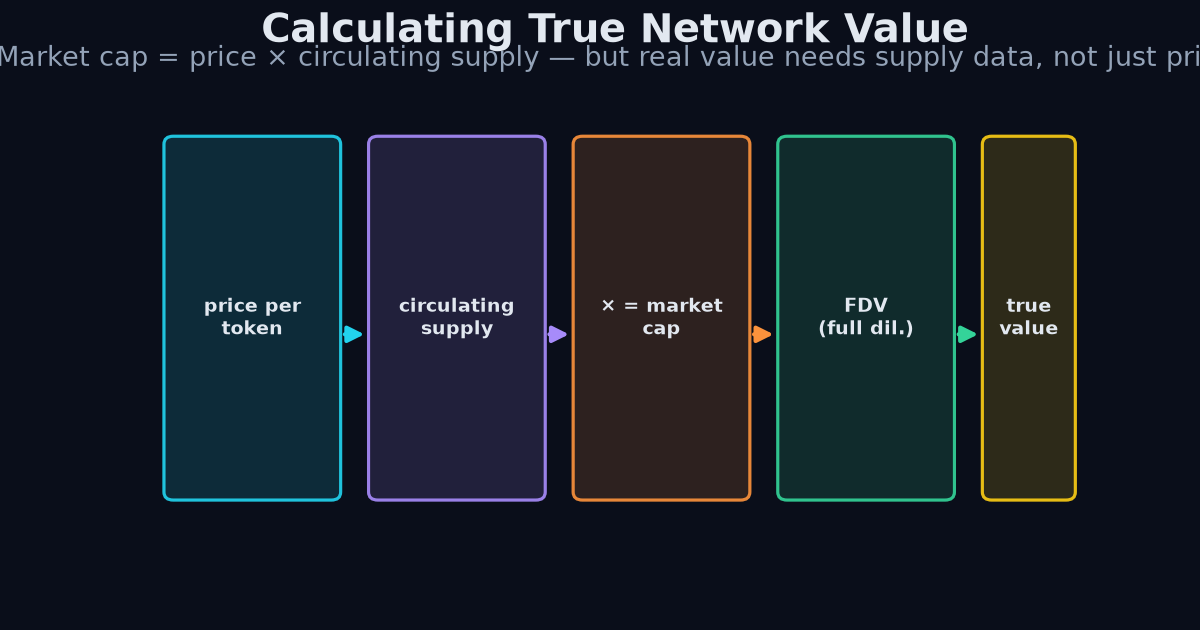
The FDV vs. Circulating Distinction
The single biggest valuation error in DePIN is treating fully diluted value (FDV) and circulating market cap as interchangeable. FDV multiplies current price by maximum supply; circulating market cap multiplies it by the tokens actually in circulation. For a network with large locked or unallocated supply — io.net, with a maximum supply far above its circulating figure, is a textbook case — the two can differ by a wide multiple.
Which number is "right" depends on the question:
- FDV approximates the value the network would command if all tokens were circulating today.
- Circulating cap reflects the value of the liquid market today.
Supply Data Is the Missing Input
Market-cap math looks trivial — price times supply — but it is only as good as its supply input. A market cap computed on a stale or inflated supply figure is a fabricated number. Because we read token supply directly from chain state (Ethereum, BSC, Solana, and others via our RPC paths) and carry a verify_url on every value, the supply input is verifiable rather than assumed.
The DePIN Data Problem
Ask anyone for the "market cap" of a DePIN network and you'll get a number. Ask where that number came from and the room goes quiet. The problem is not that DePIN tokens don't trade — it's that the supply side of the equation is a mess. Price is public, but which supply you multiply it by is a choice, and that choice changes the answer by 2–10x depending on the network.
At Kairos Signal, we catalog DePIN networks and label which carry live data and which expose first-party supply telemetry. Every value we publish carries a verify_url pointing to the exact upstream source. That provenance-first approach is exactly what market cap data needs — because market cap is a derived number, and it's only as trustworthy as its inputs.
Circulating vs. Fully-Diluted Valuation
Market cap data for DePIN splits into two questions:
- Circulating market cap — price × circulating supply. Useful for comparing against established networks, but it ignores tokens that haven't unlocked yet.
- Fully-diluted valuation (FDV) — price × max/total supply. Useful for pricing the network as if everything were in circulation today.
The Supply Data Trap
The hardest part of market cap data is not the formula — it's knowing what "supply" the source actually measured. We map 40 canonical concepts from 97 native field names across the sector, because CIRCULATING_SUPPLY, TOTAL_SUPPLY, and MAX_SUPPLY are named differently on nearly every chain. Two aggregators will show different market caps for the same network not because either is "wrong," but because they used different supply definitions.
Query It Yourself
You can pull both sides of the equation with a single call:
# Circulating supply, max supply, and market data for a DePIN network
curl "https://kairossignal.com/v1/networks/io.net" \
  -H "X-API-Key: $KS_API_KEY"
Compare canonical supply concepts across many networks at once
curl "https://kairossignal.com/v1/compare?concept=CIRCULATING_SUPPLY"
Every field in the response carries a verify_url — for supply data it points at the network's own API or chain explorer; for market data it points at CoinGecko or DefiLlama. Compute the ratio yourself, and you'll never be fooled by an FDV dressed up as a market cap.
Why Provenance Wins
Bitcoin-anchored provenance means each daily batch is Merkle-rooted and timestamped via OpenTimestamps. When you backtest against our market cap data, you get the supply value that was true that day — not a later-restated figure that would silently corrupt your analysis.
Market cap data is only as good as its supply input. Verify the supply, and you can trust the number. Get a free API key →---
This is a data product. Kairos Signal publishes no trading signals, performance returns, win rates, or accuracy claims.---
Try it yourself
Query the live catalog, supply telemetry, and provenance receipts directly: /v1/supply, /v1/provenance on the REST API.
Related reading: why supply data matters more than price · DePIN on-chain data · DePIN analytics pipeline · what to evaluate in a DePIN data platform
Start with a free API key — $5 in credits, no credit card — and query the live networks, their series, and the MCP server. Try the API free → · See pricing
---
Get Started With DePIN Intelligence
Kairos Signal provides verifiable, provenance-first telemetry for DePIN networks, including first-party supply data read directly from a network's own API or blockchain. Every value carries a verify_url you can check yourself, and each daily batch is Merkle-rooted and anchored to Bitcoin.
Every API response is signed with ed25519 and timestamped. You can prove what was served and when, months later. That is what we mean by provenance-first.
Related reading: DePIN Intelligence Guide · DePIN Telemetry · How to Query DePIN Data · DePIN Data Verification · Pricing Correction 2026-09-25: this post called our catalog entry count a count of DePIN networks; that count includes superseded rows and Bittensor subnet rows. It has been removed, together with some present-tense coverage counts written beside it. Current coverage figures: /v1/networks.