The DePIN Data Problem
What Transparency Actually Means for DePIN
Transparency in DePIN has two distinct halves, and conflating them produces bad data products. The first is source transparency: can you trace a number to the upstream source that produced it? The second is gap transparency: does the provider tell you what it does not cover? A provider can be fully source-transparent on the data it serves and still hide a gaping hole in coverage by silently omitting networks it cannot measure.
At Kairos Signal we treat both as requirements. Every value carries a verify_url, and every network we cannot observe is explicitly labeled catalog_only rather than quietly dropped from the count. Naming the gaps is as important as naming the sources — it is the only way a consumer can tell a measurement from an absence.
The Cost of Intransparent Data
Untransparent DePIN data has real, compounding costs. An investor who relies on a fabricated node count builds a valuation on fiction. A developer who trusts a stale supply figure provisions against a market that no longer exists. An agent that consumes a zero-filled missing value acts on a number that was never measured.
The fix is structural, not cosmetic: provenance on every value, freshness verdicts on every reading, and explicit labels on every gap. That is the transparency standard we hold our own data to, and the standard we would want any DePIN data provider to meet.
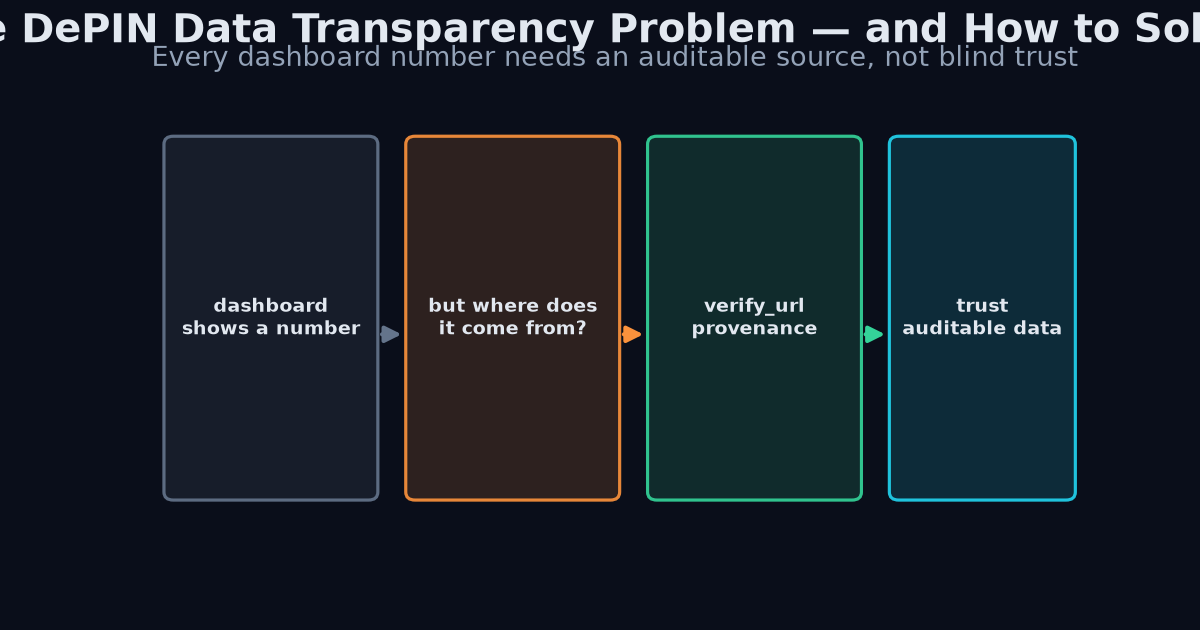
DePIN is supposed to be the transparency sector. The networks run on open, auditable ledgers. And yet, ask for the supply number behind any DePIN dashboard and you'll usually hit a wall. Where did "50,000 GPUs" come from? When was it measured? Is it registered or active? The answer, more often than not, is: nobody can tell you.
That's the DePIN data transparency problem. A sector built on verifiability ships its analytics as unverifiable assertions.
The Root Causes
Three failures produce the opacity:
The Fix Is Provenance-First Data
We think the solution is a set of concrete, enforceable practices — not a promise to "be more transparent":
- A
verify_urlon every value. Every metric links to its exact upstream source — the network's own API, a chain explorer, an aggregator. You can open it and confirm. - A declared unit and comparability grade on every concept. Forty canonical concepts, mapped from 97 native field names, each with a unit and a label for how confidently it can be compared across networks.
- Bitcoin-anchored provenance. Each daily batch is Merkle-rooted and timestamped to Bitcoin via OpenTimestamps. The number you read today is provably the number published today — and tomorrow's archive still holds today's value.
- Published refusals. When a metric can't be verified or mixes incompatible units, we refuse to publish it — and we print the refusal, rather than hiding it.
Query a Transparent Data API
# A network with every field carrying a verify_url
curl "https://kairossignal.com/v1/networks/filecoin" \
  -H "X-API-Key: $KS_API_KEY"
Canonical, unit-declared concepts across networks
curl "https://kairossignal.com/v1/compare?concept=STORAGE_CAPACITY&networks=filecoin,storj,arweave" \
  -H "X-API-Key: $KS_API_KEY"
Open any verify_url in the response and compare. The point is that you can. Transparency isn't a claim we make about ourselves — it's a property of the response.
Why It Matters
For researchers, transparency is what makes DePIN data usable instead of decorative. For investors, it's the difference between a thesis and a guess. For AI agents, it's the difference between making a decision and gambling. Verifiable, timestamped, unit-declared data is the only kind a machine can safely act on.
The transparency problem in DePIN isn't unsolvable. It's just a choice about how data ships. Get a free API key →---
This is a data product. Kairos Signal publishes no trading signals, performance returns, win rates, or accuracy claims.---
Try it yourself
Query the live catalog, supply telemetry, and provenance receipts directly: /v1/supply, /v1/provenance on the REST API.
Related reading: DePIN Intelligence guide · DePIN network data: 372 networks, 138 sources · how we read supply telemetry from 296 networks · the DePIN developer guide
Start with a free API key — $5 in credits, no credit card — and query the live networks, their series, and the MCP server. Try the API free → · See pricing
---
Get Started With DePIN Intelligence
Kairos Signal provides verifiable, provenance-first telemetry for DePIN networks, including first-party supply data read directly from a network's own API or blockchain. Every value carries a verify_url you can check yourself, and each daily batch is Merkle-rooted and anchored to Bitcoin.
Every API response is signed with ed25519 and timestamped. You can prove what was served and when, months later. That is what we mean by provenance-first.
Related reading: DePIN Intelligence Guide · DePIN Telemetry · How to Query DePIN Data · DePIN Data Verification · Pricing