The Oracle Problem, Made Verifiable
Getting Started
Adopting verifiable provenance does not require a big migration — it starts with asking whether the data you already consume is checkable. For any feed your protocol or strategy depends on, ask: does every value carry a source, a timestamp, and a way to verify it at the origin? If not, the risk is unquantified.
With Kairos Signal, every value carries source, as_of, verify_url, and freshness_verdict, and every daily batch is Merkle-rooted to Bitcoin. That is the provenance envelope a DeFi integration should demand before trusting off-chain data with on-chain consequences.
DeFi's foundational risk is the oracle problem: smart contracts execute on data they cannot verify. A price feed, a supply figure, or a utilization metric that is wrong or manipulated flows directly into liquidations, collateralization, and strategy returns. Provenance — the ability to trace a value to its source and prove it was not altered — is the mechanism that turns an unverifiable feed into a trustworthy one.
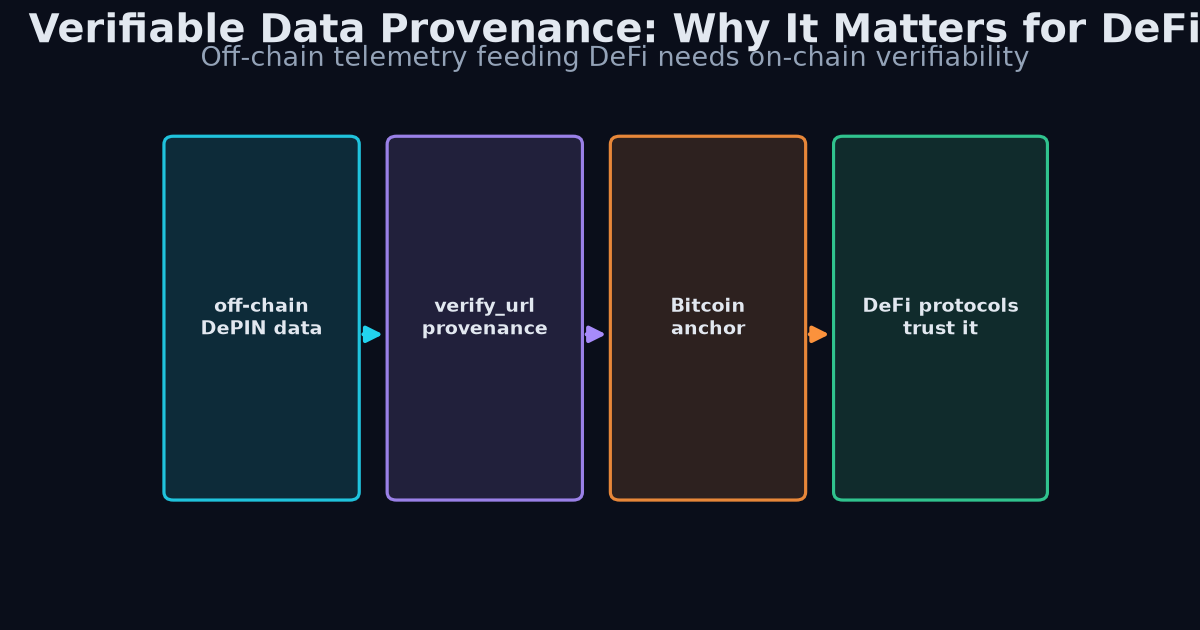
At Kairos Signal, every value we serve carries four provenance fields: source (the upstream API or chain), as_of (exact read time), verify_url (a public URL to confirm the reading), and freshness_verdict (fresh, stale, or missing). On top of that, each daily batch is Merkle-rooted and anchored to Bitcoin via OpenTimestamps, so any historical value can be cryptographically proven to have existed at a specific time.
Why This Matters for Smart Contracts and Agents
An autonomous agent or smart-contract integration cannot afford to trust a dashboard. It needs machine-readable, cryptographically verifiable data it can act on. With provenance-first data:
- A lending protocol can verify the collateralization inputs before liquidating.
- A trading agent can confirm a supply figure before sizing a position.
- An infrastructure allocator can validate utilization before provisioning compute.
The Trust Gap in DeFi Data
DeFi protocols increasingly depend on off-chain data — oracle feeds, supply telemetry, network health metrics — to price assets, allocate capital, and trigger liquidations. But most of that data has no provenance. You're trusting a black box: a dashboard, an aggregator, or an API whose numbers can't be independently verified.
For DeFi, that's a structural risk. A manipulation-resistant system built on unverifiable inputs is only as sound as its weakest feed.
What Provenance Actually Gives You
1. Manipulation resistance. When every value carries averify_url pointing to the upstream source, an attacker can't silently inject a plausible-looking number. Anyone can check the value against the origin. This is the difference between "the network reports 10,000 GPUs" and "10,000 GPUs, verifiable at the source."
2. Time anchoring. Kairos Signal Merkle-roots every daily data batch and timestamps it to Bitcoin via OpenTimestamps. The Merkle root is embedded in a Bitcoin transaction, so there's a cryptographic proof that a specific set of data existed at a specific time — without trusting us or any third party. This makes data tamper-evident after the fact.
3. Auditability. Verifiable data turns "trust the number" into "audit the number." For DeFi protocols subject to governance, risk committees, or regulatory scrutiny, the ability to prove a data point's origin and timestamp is a material improvement over opaque feeds.
Why DeFi Needs It Now
DeFi's whole thesis is trust minimization — code you can audit, collateral you can verify. But that rigor has rarely extended to the data layer. As DeFi starts to price DePIN collateral and physical-infrastructure health, unverifiable off-chain telemetry becomes the weakest link.
Consider a lending protocol that uses a network's registered storage capacity as a collateral-health metric. Without provenance, a manipulated capacity figure could inflate or deflate collateral valuations. With Bitcoin-anchored, Merkle-rooted, source-verifiable data, the protocol's risk model stands on inputs it can check.
Build on Verifiable Data
For developers building DeFi on DePIN, the standard should be: every input has a source, a timestamp, and a cryptographic anchor.
Get a free API key and query verifiable DePIN data → — $5 in free credits on signup. See the API docs and pricing for provenance features. Explore design-partner access for protocol-grade data →---
This is a data product. Kairos Signal publishes no trading signals or accuracy claims. All values are measured facts with verifiable provenance.---
Try it yourself
Query the live catalog, supply telemetry, and provenance receipts directly: /v1/networks, /v1/supply on the REST API.
Related reading: DePIN data provenance · Merkle-rooted batch integrity · how verify_url works · how we verify every DePIN number
Design-partner seats are capped at 20 at a lifetime-locked $199/mo (full API access, every published endpoint, MCP server, Bitcoin-anchored provenance). After seat 20 the price becomes $249/mo. Claim a design-partner seat → · See pricing---
Get Started With DePIN Intelligence
Kairos Signal provides verifiable, provenance-first telemetry for DePIN networks, including first-party supply data read directly from a network's own API or blockchain. Every value carries a verify_url you can check yourself, and each daily batch is Merkle-rooted and anchored to Bitcoin.
Every API response is signed with ed25519 and timestamped. You can prove what was served and when, months later. That is what we mean by provenance-first.
Related reading: DePIN Intelligence Guide · DePIN Telemetry · How to Query DePIN Data · DePIN Data Verification · Pricing