Telemetry as a Training Signal
DePIN networks produce an enormous, continuous stream of machine-readable data: node counts, supply, utilization, fees, and on-chain activity. That data is not just for dashboards — it is a training signal for AI. Models that learn how infrastructure networks behave can forecast utilization, detect divergence, and automate diligence.
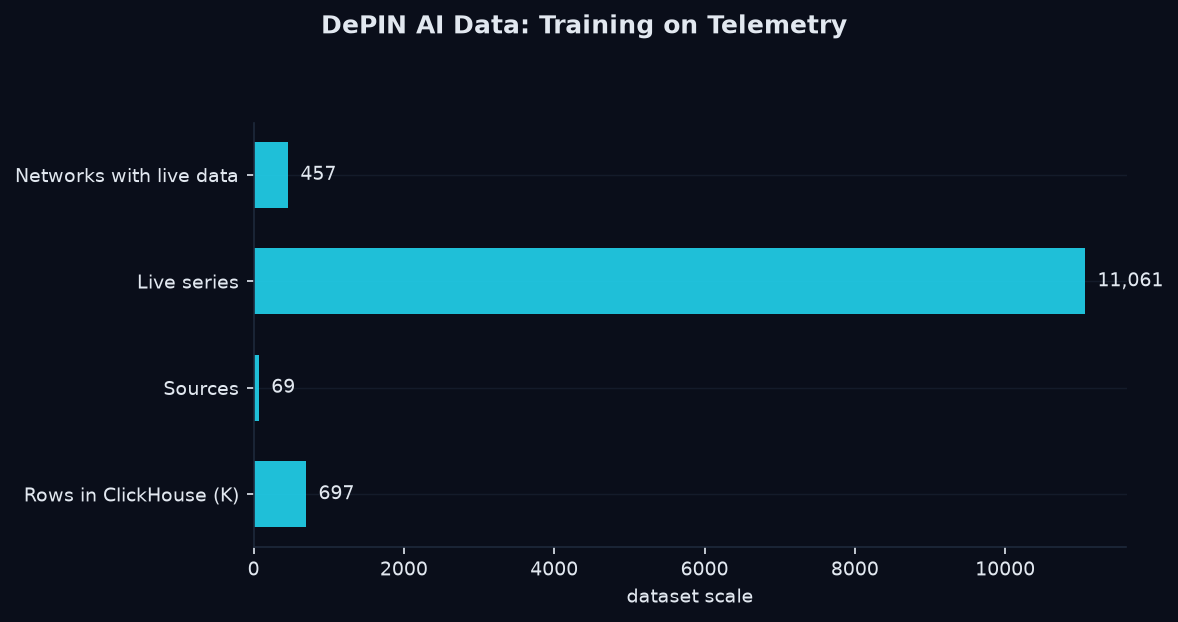
The dataset is real and substantial:
- 372 networks with live data
- 11,857 live series
- 69 data sources
- ~697K rows in ClickHouse
What You Can Build
- Utilization forecasting — predict GPU supply tightness from historical registered-vs-active divergence.
- Anomaly detection — flag networks whose node counts or fees diverge from their own history.
- Cross-network models — because data is normalized into 38 canonical concepts, a model can learn patterns that transfer across Akash, io.net, Render, Filecoin, and more.
- Diligence automation — agents that score networks on revenue, utilization, and committed capital.
Why Verifiable Data Wins for AI
Training a model on bad data bakes the errors in. Scraped or modeled data carries the scraper's assumptions; a model trained on it learns those assumptions as truth. Verifiable data is different:
- Every value carries a
source,as_of, andverify_urlyou can check. - Missing values are labeled, never zero-filled — so the model isn't learning from fabricated zeros.
- Daily batches are Merkle-rooted and anchored to Bitcoin via OpenTimestamps — so historical training data is provably unaltered and point-in-time.
The Zero-Fill Danger in Training Sets
The most insidious training-data bug is the zero-fill. A dataset that returns 0 for a missing node count teaches the model that "network has zero nodes" is a normal state. In a training corpus of thousands of rows, a handful of fabricated zeros can skew an entire model's prior. Verifiable data with a missing verdict lets your training pipeline exclude or impute honestly — never teaching the model a lie.
The Temporal Edge
The best AI training data is temporal, and temporal history cannot be bought. We have accumulated ~697K rows of daily telemetry, meaning models can train on weeks of genuine history rather than a snapshot. A model trained on temporal patterns — how utilization changes, not just its level — is fundamentally more useful than one trained on a single point in time.
Feed a Model Programmatically
# Bulk pull a series for training
curl "https://api.kairossignal.com/v1/supply?network=akash&metric=gpu_active&window=90d" \
  -H "X-API-Key: *"
Pull normalized features across many networks
curl "https://api.kairossignal.com/v1/compare?concept=GPU_UTILIZATION"
Full network feature set
curl "https://api.kairossignal.com/v1/networks/io.net"
Every response is machine-readable with full provenance, so your training pipeline can audit its own inputs.
Feature Engineering on Canonical Concepts
Because data is normalized into 38 canonical concepts, feature engineering is dramatically simpler. You build features like registered_vs_active_ratio, fee_trend_30d, or utilization_zscore once, and they apply across every network — instead of hand-crafting per-network features from incompatible schemas. That's a structural advantage for any ML workflow over DePIN.
FAQ
What makes DePIN telemetry good training data? It's continuous, machine-readable, temporal, and now verifiable. Models can learn cross-network patterns that a single network's data can't reveal. Why does verification matter for training? A model trained on bad data bakes the errors in. Verifiable data withmissing verdicts and Bitcoin-anchored history means the model learns reality, not restatements or fabricated zeros.
Can an agent consume this data? Yes — programmatically via the REST API or MCP server, with full provenance on every value.
Explore the data → · Get a free key →
The Point-in-Time Requirement for Training
The single most important property of training data for time-series models is that it be point-in-time — that each value reflects what was true at its timestamp, not what was later restated. Restated supply or node counts corrupt a model because they teach it relationships that never actually held. Bitcoin-anchored batches guarantee point-in-time data: the value you train on is provably the value that was true that day, unaltered and un-restated.
The Cross-Network Advantage
Because DePIN telemetry normalizes into 38 canonical concepts, an ML model can learn patterns that transfer across networks. A model trained on Akash's registered-vs-active divergence can generalize to io.net or Render, because the features are the same canonical concepts. That cross-network generalization is impossible with per-network native schemas — and it's exactly what makes a canonical dataset disproportionately valuable for AI.
Read more: Autonomous Agent Data · DePIN Analytics · DePIN Data Feeds
---
This is a data product. Kairos Signal publishes no trading signals, performance returns, win rates, or accuracy claims.---
Try it yourself
Query the live catalog, supply telemetry, and provenance receipts directly: /v1/provenance on the REST API.
Related reading: DePIN Intelligence guide · DePIN network data: 372 networks, 138 sources · how we read supply telemetry from 296 networks · the DePIN developer guide
Design-partner seats are capped at 20 at a lifetime-locked $199/mo (full API access, every published endpoint, MCP server, Bitcoin-anchored provenance). After seat 20 the price becomes $249/mo. Claim a design-partner seat → · See pricing---
Get Started With DePIN Intelligence
Kairos Signal provides verifiable, provenance-first telemetry for DePIN networks, including first-party supply data read directly from a network's own API or blockchain. Every value carries a verify_url you can check yourself, and each daily batch is Merkle-rooted and anchored to Bitcoin.
Every API response is signed with ed25519 and timestamped. You can prove what was served and when, months later. That is what we mean by provenance-first.
Related reading: DePIN Intelligence Guide · DePIN Telemetry · How to Query DePIN Data · DePIN Data Verification · Pricing