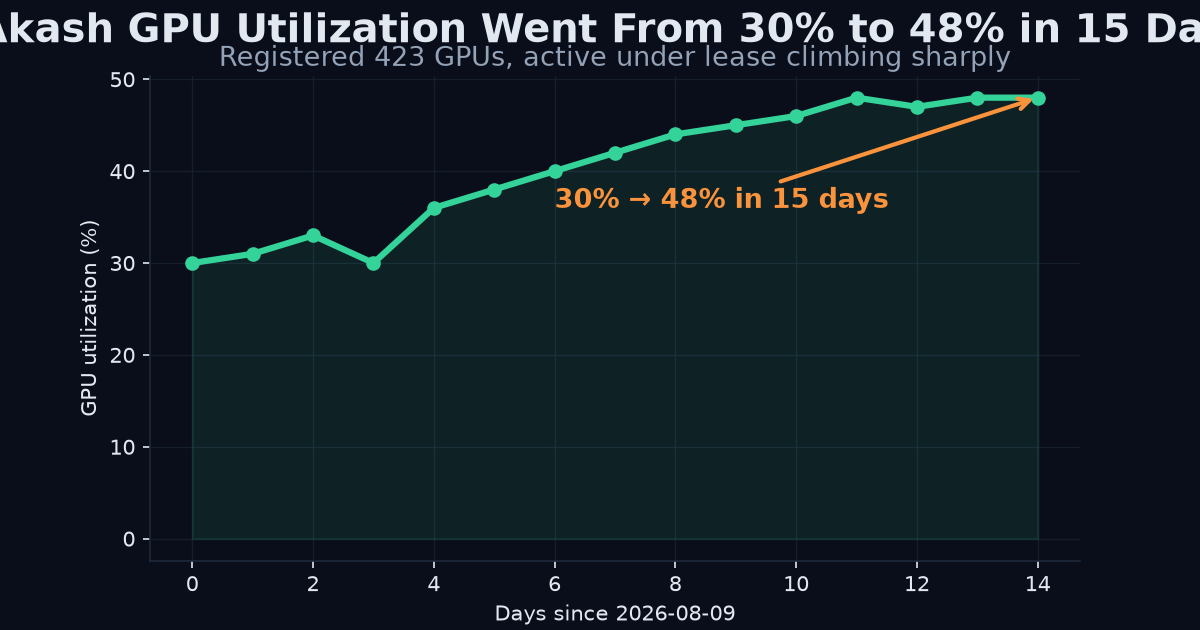
Akash GPU Utilisation Went From 30% to 48% in 15 Days
On 2026-08-09 — the first row of our depin_utilisation_daily series — Akash Network had 127 of 423 GPUs under active lease: 30.0%.
Fifteen days later, checked live against Akash's own API at 2026-08-24T14:23Z, the network reports 212 GPUs active out of 440 total: 48.2%.
That is +18 percentage points in 15 days. And the important part is what didn't move.
The denominator stayed flat
There are two ways a utilisation ratio can climb: demand grows, or supply shrinks. Networks that quietly lose providers post rising "utilisation" numbers that mean the opposite of what they look like. So before we call anything a demand ramp, we check the denominator.
- 2026-08-09 (our first daily snapshot): 127 leased / 423 total GPUs = 30.0%
- 2026-08-23 (latest daily snapshot): 201 leased / 427 total GPUs = 47.1%
- 2026-08-24T14:23Z (live check this run against
console-api.akash.network): 212 active + 1 pending, 227 available, 440 total = 48.2% leased
We flagged the early innings of this in our August 13 note (io.net's registered devices grew 26% while active stayed flat) — at that point Akash GPU utilisation had gone 30% → 43% over Aug 9–12, with available GPUs shrinking from 294 to 244. The trend held through the following twelve days.
What's actually being leased
"440 GPUs" is not one product. The Akash fleet spans datacenter and prosumer SKUs — H100, H200, A100, RTX 5090 among them — and they are not interchangeable for buyers. We track per-model ALLOCATABLE and ALLOCATED counts plus min/median/max hourly pricing for roughly 25 GPU models daily in our depin_onchain store (latest write for this series: 2026-08-24T13:44:01Z). That per-SKU history is what turns a headline ratio into something an allocator can use: a network can be 48% utilised overall while its H100s are effectively sold out and its consumer cards sit idle — or vice versa. The blended number alone cannot tell you which.
CPU tells the opposite story, from the same API call
Same endpoint, same timestamp: 3,824,480 of 15,396,710 CPU milli-cores active — 24.8%. Three-quarters of Akash's CPU capacity is idle while nearly half its GPUs are leased.
That divergence is the finding. On Akash today, GPUs are the scarce resource and general compute is abundant. If you're pricing capacity, deciding where to deploy hardware, or evaluating AKT's fee-generating base, the GPU line and the CPU line are different businesses that happen to share a marketplace.
(One unit warning we learned the hard way: Akash reports CPU in milli-cores — 1000 per core. Anyone dividing raw numbers without catching that is off by three orders of magnitude.)
Method and caveats
Honesty about the denominator is the whole product, so:
- "Leased" here means
active / totalfrom Akash's network-capacity endpoint. Pending leases (1 GPU at check time) are excluded from the numerator; including them gives 48.4% — immaterial today, but we state the choice. - This is provider-declared capacity. The 440-GPU denominator is what registered providers advertise as allocatable. It does not include GPUs that exist but were never registered on Akash, and a provider that misdeclares capacity distorts the ratio. It's the same denominator Akash's own console uses, so the series is internally consistent — but it measures the marketplace, not the world.
- Point-in-time matters. Our daily snapshots are archived as-observed. When an upstream API restates history — and we've caught networks doing exactly that — our series keeps both values with their timestamps. The 30.0% for Aug 9 is what was observable on Aug 9.
- 15 days is a short window. The direction and magnitude are real and verified at both endpoints of the window, but we make no claim about what happens next. We publish the series; we don't extrapolate it.
- Caveats travel with every metric we publish, not just this one — the same way our military-aircraft counts are explicitly transponder-visible-only and our GPS-jamming maps carry receiver-density bias notes. A number without its denominator choice attached is an opinion.
Verify it yourself
You should not have to trust us. The upstream is public:
# Akash's own network-capacity endpoint (the source for the live check above)
curl https://console-api.akash.network/v1/network-capacity
-> resources.gpu: {active, pending, available, total}
-> resources.cpu in MILLI-cores
Our tracked Akash metrics, with provenance on every value
curl https://kairossignal.com/v1/network/AKT -H "X-API-Key: YOUR_KEY"
Cross-network utilisation comparison
curl "https://kairossignal.com/v1/compare?metric=gpu_utilization" -H "X-API-Key: YOUR_KEY"
Every response from our API carries source, as_of, age_hours, and a verify_yourself URL pointing at the upstream. The utilisation page at kairossignal.com/utilisation publishes the ratios and the denominators we refused to use. Full endpoint reference is in the API docs, and you can poke the data without a key at /try.
For the how-to on querying Akash specifically, see Akash Network API: query providers, compute, revenue.
What we can't hand you over a public URL is the history: the daily per-SKU GPU series starts 2026-08-09 and grows a row per network per day. Akash's endpoint tells you it's 48.2% now. Our archive is how you know it was 30.0% fifteen days ago.
---
Data access: free tier with $5 credits (no card) or the $199 Design Partner plan for full history and per-SKU GPU series.---
Try it yourself
Query the live catalog, supply telemetry, and provenance receipts directly: /v1/networks, /v1/supply on the REST API.
Related reading: Akash network data · akash api · akash network compute pricing api how to query · compute supply across Akash, io.net, Aethir
Design-partner seats are capped at 20 at a lifetime-locked $199/mo (full API access, every published endpoint, MCP server, Bitcoin-anchored provenance). After seat 20 the price becomes $249/mo. Claim a design-partner seat → · See pricing---
Get Started With DePIN Intelligence
Kairos Signal provides verifiable, provenance-first telemetry for DePIN networks, including first-party supply data read directly from a network's own API or blockchain. Every value carries a verify_url you can check yourself, and each daily batch is Merkle-rooted and anchored to Bitcoin.
Every API response is signed with ed25519 and timestamped. You can prove what was served and when, months later. That is what we mean by provenance-first.
Related reading: DePIN Intelligence Guide · DePIN Telemetry · How to Query DePIN Data · DePIN Data Verification · Pricing